
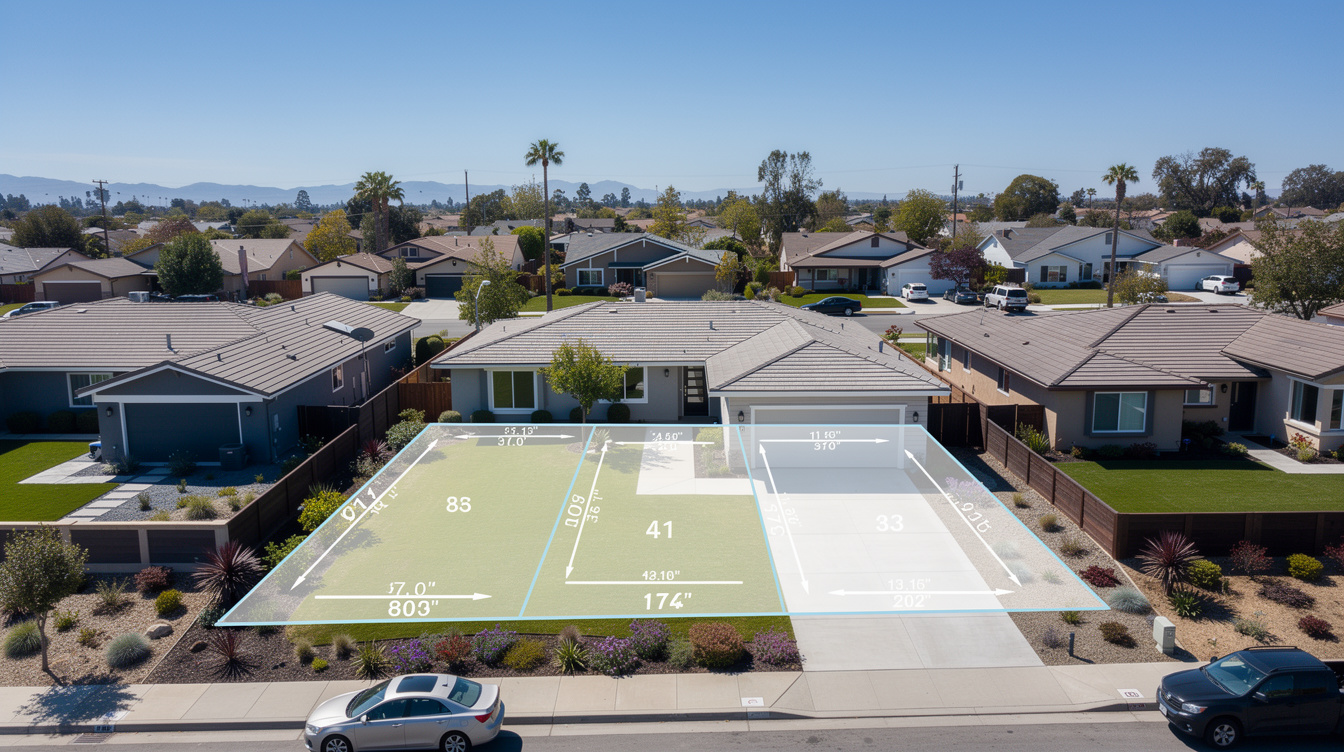
TL;DR: An ADU adds a rentable second unit to your existing lot — faster, cheaper ($90K–$450K), and simpler. An SB 9 lot split legally divides your parcel into two sellable lots ($20K–$80K for the split alone), enabling you to build up to 4 units total or sell off land. Choose an ADU for rental income; choose SB 9 when you want to unlock maximum land value, sell a parcel, or develop at greater scale. You can do both — but it takes planning, legal guidance, and capital.
What is SB 9 and how does it work?
Senate Bill 9 (SB 9), signed by Governor Newsom in September 2021 and effective January 1, 2022, fundamentally changed single-family zoning in California. Under SB 9, most single-family homeowners in California can now do two things that were previously prohibited in most cities:
- Build a duplex on their existing single-family lot (converting it to a two-unit property)
- Subdivide their parcel into two separate legal lots, each of which can then contain up to two residential units
The subdivision component — the "lot split" — is what makes SB 9 transformative. Once you split your parcel, you own two separate legal lots. You can keep both, sell one, or develop both independently. According to California HCD, the lot split provision requires the resulting lots to each be at least 1,200 square feet, and the original parcel must be at least 2,400 square feet to qualify.
There are important eligibility restrictions under SB 9. The property must be in an urbanized area or urban cluster, must not be in a historic district, must not be in high fire hazard severity zones in most cases, and the applicant must sign an affidavit affirming owner-occupancy in one of the units for at least three years following the lot split. Cities cannot apply additional design standards beyond objective zoning criteria, though some jurisdictions have attempted local ordinances to limit SB 9's reach.
For a deep dive on California housing law compliance, see our ADU legal guide.
What is an ADU and how is it different?
An Accessory Dwelling Unit (ADU) is a second, fully independent residential unit on the same lot as a single-family home. It has its own kitchen, bathroom, and living space. ADUs can be detached (a separate structure in the backyard), attached (an addition to the main house), or converted from existing space (garage, basement, or extra room).
Unlike SB 9, an ADU does not change your parcel configuration — you remain the owner of a single legal lot containing two residential units. You cannot sell the ADU separately from the main home (unless you later pursue a condominium conversion, which is a separate legal process). The ADU is a rental unit or family housing option that stays with the property.
Under California state law (AB 68, AB 881, AB 3182, and subsequent amendments), ADU permitting has been dramatically streamlined. Most California cities must approve ADUs ministerially — no discretionary review, no neighborhood hearings. According to California HCD, over 24,000 ADU permits were issued statewide in 2023, making California the leading ADU market in the US. For planning specifics in your jurisdiction, visit our ADU planning guide.
Free Resource
Download the Free 2026 California ADU eBook
Everything you need to plan, permit, finance, and build your ADU — in one free guide. 60+ pages written for California homeowners.
Get the Free eBook →Cost comparison: ADU vs. SB 9 lot split
Cost is where these two paths diverge most significantly in the short term. ADUs have a straightforward cost profile: design, permits, and construction. SB 9 lot splits layer on substantial legal, surveying, engineering, and title work before a single shovel of dirt is turned.
| Cost Category | ADU | SB 9 Lot Split |
|---|---|---|
| Design / Architecture | $5,000 – $20,000 | $10,000 – $30,000 |
| Surveying | $0 – $3,000 | $3,000 – $8,000 |
| Legal / Title Work | $0 – $2,000 | $5,000 – $15,000 |
| Civil Engineering / Mapping | $0 – $5,000 | $10,000 – $25,000 |
| City / County Permit Fees | $3,000 – $15,000 | $5,000 – $20,000 |
| Utility Separation | $5,000 – $20,000 | $10,000 – $40,000 |
| Construction (new unit) | $90,000 – $400,000 | $150,000 – $600,000+ |
| Total All-In Range | $103,000 – $465,000 | $193,000 – $738,000+ |
Note: SB 9 cost ranges above assume you're building on the new lot after the split. If you split the lot and sell it undeveloped (the buyer builds), your net cost is just the subdivision process ($33,000–$138,000) minus the sale proceeds — which in most California markets significantly exceeds those costs. An undeveloped SB 9 lot in Los Angeles or the Bay Area can sell for $200,000–$500,000+ depending on size and zoning.
To explore financing options for either path, visit our ADU financing guide.
Timeline comparison
ADUs are significantly faster to execute than SB 9 lot splits. California's ADU law reforms have made ministerial approval the norm — most ADU permits in compliant cities are approved within 60 days. SB 9 lot splits involve a more complex approval chain including parcel map recordation, which adds months to the process.
| Phase | ADU Timeline | SB 9 Lot Split Timeline |
|---|---|---|
| Feasibility / Planning | 2 – 4 weeks | 4 – 8 weeks |
| Design / Engineering | 4 – 10 weeks | 8 – 16 weeks |
| Permit / Subdivision Approval | 4 – 8 weeks (ministerial) | 3 – 6 months (parcel map) |
| Construction | 3 – 9 months | 6 – 18 months (varies by scope) |
| Total: First Unit Occupied | 6 – 14 months | 12 – 30+ months |
Timeline caveats: Both paths can be delayed significantly by jurisdiction, plan check backlog, and contractor availability. Cities like Los Angeles, San Jose, and San Diego have streamlined ADU processing, while some smaller municipalities still impose delays through slow plan review. Under SB 9, cities are prohibited from imposing design review or conditional use permits — but recordation of the parcel map with the county is a hard step that takes 60–120 days in most counties regardless of city cooperation.
Income and ROI comparison
For pure rental income, ADUs typically deliver faster, simpler cash flow. For maximum total financial return — including land value realization — SB 9 can substantially outperform an ADU, particularly in high-value markets.
ADU rental income scenario (Bay Area garage conversion):
- Build cost: $200,000
- Monthly rent: $3,000
- Annual gross income: $36,000
- Net income (after 20% expenses): ~$28,800/year
- Payback period: ~7 years
- Property value increase: $150,000–$250,000
SB 9 lot split + sell scenario (Los Angeles 7,500 sq ft lot):
- Subdivision cost: $60,000 all-in (survey, legal, engineering, fees)
- New lot sale price: $350,000 (vacant, ready to build)
- Net profit from sale: ~$290,000
- No ongoing management required
- Timeline to liquidity: 12–18 months
SB 9 lot split + build + rent scenario:
- Subdivision + duplex build on new lot: $500,000–$700,000 total
- Two new units at $2,800/month each: $5,600/month gross, $67,200/year
- Net after expenses (~25%): ~$50,400/year
- Payback: 10–14 years, but you own two more units of California real estate
In short: an ADU is the faster, lower-risk path to rental income. SB 9 is the higher-upside, higher-complexity path for homeowners who are thinking like real estate investors.
Which one increases property value more?
An ADU typically adds 20–30% to the appraised value of your existing home — $150,000–$350,000 in most California coastal markets. That increase is embedded in the property and only realized when you sell the home.
An SB 9 lot split fundamentally changes your asset structure. Instead of one property worth, say, $900,000 with an ADU (total $1.1–$1.2M), you now own two separate legal parcels. The original home parcel may appraise lower (it's now on a smaller lot), but the second parcel has independent value. In competitive California markets:
- A sellable new lot in LA can be worth $250,000–$600,000
- A new lot in the Bay Area can command $400,000–$900,000
- Even in secondary California markets, SB 9 lots sell for $100,000–$250,000
Bottom line on value: If your goal is maximizing the total real estate value of your land, SB 9 has the higher ceiling. If your goal is increasing the value of your existing home while adding rental income, an ADU is more efficient and less disruptive.
When to choose an ADU
Choose an ADU if:
- You want rental income within 12 months with minimum legal complexity
- You have a smaller lot (under 6,000 sq ft) that doesn't support subdivision
- You want to house a family member (parent, adult child) close by
- You want the simplest permitting path — ADU approval is ministerial in most California cities
- You have a convertible garage or basement that minimizes construction costs
- You plan to keep the property long-term and want ongoing income, not a one-time sale event
- Your budget is under $250,000 and you can't finance a larger development project
An ADU is also the right choice if you simply want to improve your property without entering the more complex world of lot subdivision, parcel maps, and separate title. Most California homeowners fit this profile. See our ADU planning guide to get started.
When to choose an SB 9 lot split
Choose SB 9 if:
- You have a large lot (6,000+ sq ft) that can comfortably support subdivision and still leave both parcels usable
- You want to sell a portion of your land for a lump-sum payment rather than waiting for monthly rent
- You're thinking like a real estate developer — maximizing per-square-foot land value over time
- You want to build multiple units — SB 9 permits up to 4 units total on a split parcel (2 per lot)
- You're in a high-land-value market (Bay Area, West LA, coastal OC) where lot values justify the added complexity
- You're willing to commit to owner-occupancy for 3 years post-split (SB 9 requirement)
- You have access to construction financing for a larger-scale project
SB 9 is best suited for homeowners who are comfortable with real estate legal work, have experienced advisors (attorney, civil engineer, contractor), and are building a multi-year investment thesis rather than a simple rental unit. Our legal guide covers SB 9 eligibility requirements in depth.
Can you do both? ADU + SB 9
Yes — and it's one of the most powerful real estate strategies available to California homeowners in 2026. Here's how it can work:
Under SB 9, after splitting your lot, each resulting parcel can contain up to two residential units. Combine that with California ADU law, and you can theoretically end up with:
- Parcel A: Your existing home + an ADU = 2 units
- Parcel B: A new duplex or home + ADU = 2 units
- Total: 4 residential units on what was originally a single-family lot
This combination — often called an "SB 9 + ADU stack" — is being actively explored by California homeowners with large lots in high-demand markets. The math can be extremely compelling: four units in Los Angeles or the Bay Area generating $2,500–$4,000/month each represents $10,000–$16,000/month in gross rental income.
However, this strategy has important constraints:
- SB 9 requires owner-occupancy in one unit for 3 years after the lot split
- Both resulting lots must meet minimum size requirements (1,200 sq ft each, original parcel at least 2,400 sq ft)
- Some cities have added objective design standards that increase costs
- Utility separation for 4 units adds significant cost
- Total project cost for a full 4-unit development commonly runs $600,000–$1.2M+
If you're considering this path, start with an experienced ADU contractor and a California real estate attorney before any commitments.
Free Resource
Download the Free 2026 California ADU eBook
Everything you need to plan, permit, finance, and build your ADU — in one free guide. 60+ pages written for California homeowners.
Get the Free eBook →Bottom line
The ADU vs. SB 9 decision comes down to what you're optimizing for:
| Goal | Better Choice |
|---|---|
| Start generating rent quickly (<12–14 months) | ✅ ADU |
| Minimize legal and permitting complexity | ✅ ADU |
| House a family member nearby | ✅ ADU |
| Lower upfront budget (<$300K) | ✅ ADU |
| Maximize total land / asset value | ✅ SB 9 |
| Sell off a portion of your land | ✅ SB 9 |
| Build 3–4 units on your property | ✅ SB 9 + ADU |
| Large lot in a high-value CA market | ✅ SB 9 (or SB 9 + ADU) |
| Think like a developer, not a landlord | ✅ SB 9 |
According to California HCD, ADU permits have surpassed 24,000 statewide annually — a clear signal that most California homeowners are choosing the ADU path. SB 9 adoption has been slower due to the higher complexity and cost — but for homeowners with the right lot, market, and financial profile, it unlocks value that a single ADU simply can't match.
Not sure which path makes sense for your specific property? Start with our ADU planning guide, explore your financing options, review the legal requirements for both, and get a real project estimate from a vetted California ADU contractor.
Ready to find out what's possible on your property?
Get matched with a vetted California ADU contractor who can assess your lot, explain your SB 9 eligibility, and give you a real project estimate — not guesswork.
Find My ADU Contractor →